Returns have long been one of the most unpredictable — and costly — components of selling on Amazon. But in late-2025, Amazon rolled out new returns management insights and tools that directly benefit brand operators who are serious about controlling reverse logistics costs and customer satisfaction. [Source: Supply Chain Dive]
This update doesn’t have the flash of agentic AI or drone delivery headlines — but it may matter even more to $500K–$20M marketplace brands. Why? Because returns lean directly into margin erosion, fulfillment labor, and inventory rework costs. Slim margins make effective returns handling indispensable.
Here’s what’s new, what it means for your brand, and how to implement the changes quickly and effectively.
What’s Changing in Seller Returns Tools
Amazon’s updated returns dashboard gives sellers richer analytics and eligibility guidance than ever before, bringing transparency to what was historically a blind spot. The new features include: [Source: Supply Chain Dive]
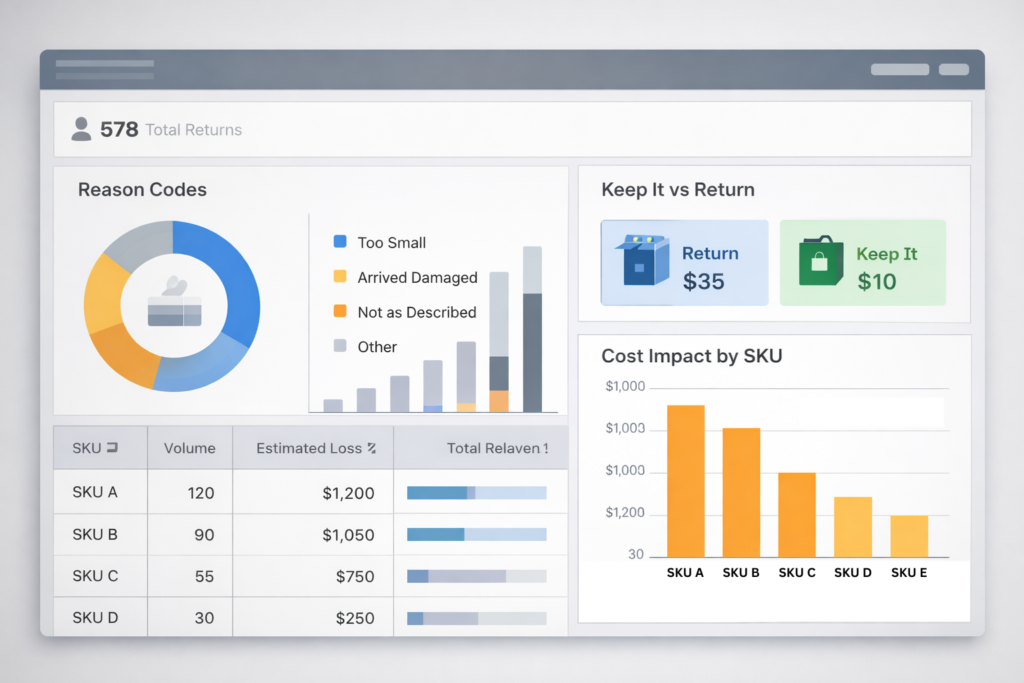
- A “keep it” eligibility indicator — helping brands decide if they should reimburse the return or let the customer keep the item
- A returns insights dashboard — showing returns trends by SKU, reason code, and customer segment
- A loss estimate model — helping calculate the projected cost impact of returns on profit, not just revenue
These improvements are designed to reduce returns cost — sometimes referred to as “reverse logistics drag” — and empower sellers to manage returns strategically rather than reactively.
Why Returns Matter More Than Ever
Across e-commerce, return rates have steadily increased. This is especially true in categories like apparel, small electronics, and home goods — where fit, expectation, or product variation often drive returns behavior.
Returns matter for three core reasons:
- Direct Cost Impact: Refunds, shipping, restocking, and potential damage on returned goods reduce overall profitability.
- Inventory Confusion: Returned items often re-enter inventory inaccurately, leading to stock miscounts and overstocking.
- Customer Experience: Poorly handled returns can drive negative feedback or lost future purchases.
Historically, Amazon’s tools gave sellers limited visibility into why items were being returned or which returns could be mitigated early. This new dashboard changes that calculus.
Key Practical Benefits for Brands
1. “Keep It” Decision Guidance
Before this change, many brands struggled with a critical question: Should I refund the customer and let them keep the item, or accept the return and absorb the associated handling cost?
The new “keep it” eligibility tool gives clear signals on which option minimizes cost while maintaining customer satisfaction. For products with low resale value or high handling costs, letting the customer keep the item often makes financial sense — and now you can see that before the decision. Supply Chain Dive
Your Action: Audit your top-10 most returned SKUs using this feature. For each, document whether the Dashboard suggests “keep it” decisions — then compare that to your prior outcomes.
2. Returns Trends by Reason Code
Understanding why products return — whether sizing, quality perception, damage, or expectation mismatch — is crucial for systematic improvement.
The upgraded insights dashboard now highlights returns reason codes with volume and cost impact. This can shift your strategy from reactive to proactive:
- If sizing is a leading cause, enhance size charts and descriptions
- If perceived quality is a driver, revise imagery and copy to reduce expectation gaps
- If damage in transit is common, improve packaging
This level of granularity was previously inaccessible without third-party tools, but now it’s native in Amazon’s interface. Supply Chain Dive
Your Action: Set a monthly returns review workflow for your team using these insights — treat it like inventory forecasting or advertising performance reviews.
3. Quantified Cost Impact
Returns aren’t just a refund — they erode net profit once shipping, processing, and potential resale issues are included.
Amazon’s new estimated loss metric brings that into focus so you can decide:
- Whether to adjust prices to buffer return risk
- Whether to subsidize expedited shipping to reduce return rates
- Whether product bundles reduce individual returns
This metric prompts strategic decisions — not just tactical ones.
Your Action: Use the estimated loss reports to recalculate SKU contribution margins quarterly.
What This Signals About Amazon’s Priorities
This wasn’t a product launch driven by vendor pressure — it reflects Amazon’s evolving operational emphasis:
- Shift from volume to margin visibility: Tools now help sellers understand profit impact, not just sales.
- Returns as a controllable cost center: Returns analytics is no longer fuzzy — it’s actionable.
- Proactive seller enablement: Brand operators with good data will be rewarded with better operational decision-making.
All three align with broader marketplace trends in 2025 toward AI-assisted operations and metric sophistication — the same movements we’ve seen in listing tools and performance dashboards. [Source: About Amazon+1]
How to Implement This Update Today
Here’s a practical rollout plan for your operations:
Step 1: Dashboard Access & Permissions
Ensure key team members have access to the new returns dashboard in Seller Central.
Step 2: Monthly Returns Reviews
Create a simple cadence where your operations or analytics team reviews returns insights by:
- SKU
- Reason
- Region
- Customer segment
Document insights and assign corrective actions.
Step 3: Update Product Listings & Packaging
Feed relationships between returns patterns and product details back into listing content, imagery, and packaging specifications.
Step 4: Training & SOPs
Train customer service and fulfillment teams on how to interpret and act on “keep it” eligibility decisions.
What Many Amazon Sellers Overlook
Too many brands think of returns as a customer service problem — but savvy operators think of returns as a profit center signal. Now that Amazon provides more data:
- You can treat returns metrics like inventory forecasting
- You can integrate returns insights into product roadmaps
- You can align returns outcomes with pricing strategy
This shift elevates returns from an annoyance to a strategic advantage.