Amazon AWD Changes in 2026
Amazon has continued expanding its supply chain ecosystem in 2026, making Amazon Warehousing & Distribution (AWD) more than just a bulk storage program. It’s becoming a central component of Amazon’s end-to-end logistics strategy, connecting overseas freight, long-term storage, automatic FBA replenishment, and even fulfillment for non-Amazon channels.
For sellers, that means AWD is no longer something to ignore. Whether you’re trying to avoid stockouts, reduce inbound placement costs, or simplify inventory management, understanding the latest AWD changes can directly impact your profitability.
What Is Amazon Warehousing & Distribution (AWD)?
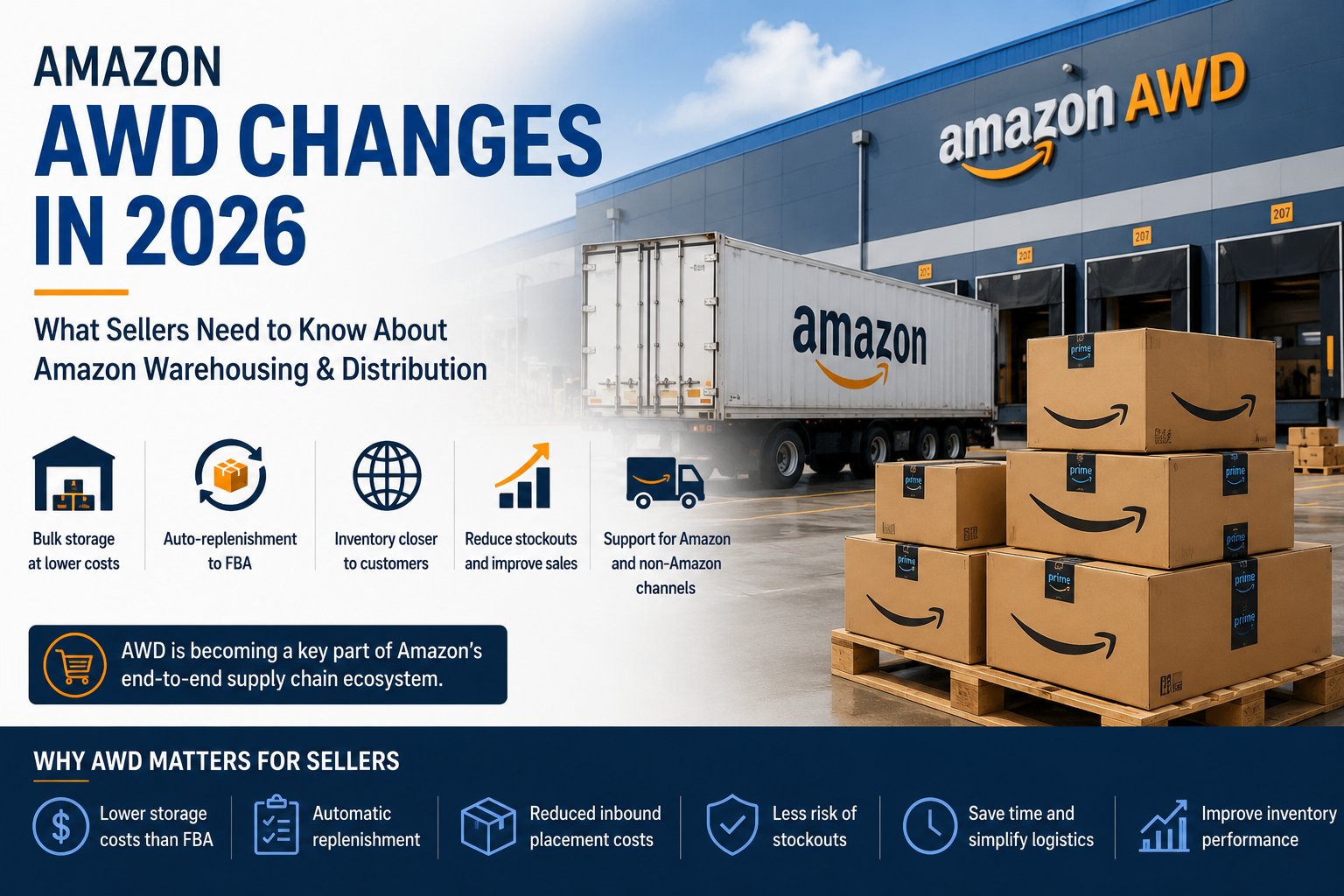
Amazon Warehousing & Distribution (AWD) is Amazon’s low-cost bulk storage solution designed to hold inventory before automatically replenishing Fulfillment by Amazon (FBA) warehouses.
Instead of sending all inventory directly into FBA, sellers can store products in AWD distribution centers where Amazon manages replenishment based on demand forecasts.
Benefits include:
- Lower-cost bulk storage than keeping excess inventory inside FBA
- Automatic replenishment into Amazon fulfillment centers
- Reduced stockout risk
- Inventory distribution closer to customer demand
- Support for both Amazon and certain non-Amazon fulfillment channels
Amazon has continued positioning AWD as the upstream inventory solution for sellers looking to scale operations more efficiently.
AWD Is Becoming Part of Amazon’s Bigger Supply Chain Vision
One of the biggest developments in 2026 isn’t simply a fee update.
Amazon has begun rebranding Supply Chain by Amazon into Amazon Supply Chain Services, signaling a broader strategy that extends well beyond marketplace fulfillment.
Rather than offering individual logistics services, Amazon is increasingly connecting:
- Amazon Global Logistics (AGL)
- Amazon Warehousing & Distribution (AWD)
- Partner Carrier Program (PCP)
- Fulfillment by Amazon (FBA)
- Multi-Channel Fulfillment (MCF)
The goal is simple: allow sellers to move products from manufacturers to customers with fewer third-party providers involved.
Existing AWD users won’t need to make changes, but the direction is clear—Amazon wants sellers using more of its logistics ecosystem instead of piecing together outside providers. Activate $5 Cash Back
Auto-Replenishment Continues to Be AWD’s Biggest Advantage
For many sellers, the most valuable AWD feature remains Auto-Replenishment.
Instead of manually creating replenishment shipments into FBA, Amazon monitors inventory levels and transfers products automatically when additional stock is needed.
This offers several advantages:
- Fewer stockouts
- Reduced manual inventory planning
- Better geographic inventory placement
- Improved delivery speeds
- Less time spent creating replenishment shipments
Amazon states that Auto-Replenishment uses demand forecasting to keep FBA inventory available while minimizing unnecessary overstock.
AWD Can Help Reduce Inbound Placement Costs
Since Amazon introduced inbound placement service fees, many sellers have looked for ways to reduce the cost of sending inventory into multiple fulfillment centers.
One benefit of AWD is that inventory transferred from AWD into FBA includes inbound placement within the program, eliminating the separate FBA inbound placement fee for those replenishment shipments.
For brands shipping large volumes throughout the year, this can simplify inbound logistics while reducing some fulfillment costs.
Amazon Continues Investing in AWD Instead of Traditional FBA Storage
Amazon has repeatedly encouraged sellers to move long-term inventory out of FBA and into AWD.
Rather than filling fulfillment centers with months of inventory, Amazon prefers:
- Fast-moving inventory inside FBA
- Bulk inventory inside AWD
- Automated replenishment between the two
This allows Amazon to reserve valuable fulfillment center space for products that are actively shipping while using AWD as upstream storage.
For sellers, it often creates a cleaner inventory flow and reduces the risk of aged FBA inventory.
What Sellers Should Watch in 2026
Although AWD continues adding new capabilities, sellers should also be aware of recent pricing changes.
Beginning in 2026, Amazon announced:
- Higher AWD transportation fees
- Increased West Region storage pricing
- Additional box handling fees for certain shipments
While these increases won’t affect every seller equally, brands heavily relying on AWD should review their landed costs and determine whether adjustments to inventory placement or replenishment strategies make sense.
When Does AWD Make Sense?
AWD isn’t the right solution for every business.
However, it becomes increasingly valuable if you:
- Carry several months of inventory
- Frequently experience FBA stockouts
- Import products from overseas
- Sell year-round instead of seasonally
- Want Amazon managing replenishment
- Need to reduce inbound placement complexity
Many high-volume brands now treat AWD as an extension of their warehouse rather than simply another Amazon program.
When a 3PL May Still Be Better
Despite Amazon’s growing logistics network, third-party logistics providers (3PLs) still have advantages in certain situations.
A 3PL may be a better fit if you:
- Require custom kitting or assembly
- Need frequent packaging changes
- Serve multiple retail channels equally
- Want greater operational flexibility
- Maintain highly customized inventory workflows
Many brands continue using a hybrid strategy—holding reserve inventory in AWD while relying on a 3PL for specialized fulfillment.
Best Practices for Sellers Using AWD
If you’re planning to use Amazon Warehousing & Distribution in 2026, consider the following best practices:
- Enable Auto-Replenishment whenever appropriate.
- Monitor transportation and storage fees regularly.
- Compare AWD costs against your current 3PL.
- Keep inventory flowing instead of storing excessive quantities long term.
- Review demand forecasts before peak selling seasons.
- Evaluate whether AWD can reduce inbound placement expenses.
Amazon Is Building a Fully Integrated Supply Chain
The biggest takeaway from Amazon’s AWD changes isn’t simply that fees have changed or new features have been introduced.
It’s that Amazon is steadily creating a logistics ecosystem where sellers can manage freight, storage, replenishment, fulfillment, and delivery within a single network.
For many brands, this offers opportunities to simplify operations, reduce manual inventory management, and improve in-stock performance. At the same time, sellers should continue evaluating costs, flexibility, and operational needs to determine whether AWD, a third-party logistics provider, or a combination of both delivers the best long-term results.
Sources
- Amazon Warehousing & Distribution Overview: https://sellingpartners.aboutamazon.com/amazon-warehousing-distribution
- Amazon Seller Central – Amazon Warehousing & Distribution: https://sellercentral.amazon.com/help/hub/reference/external/GF6ZC8VEBM7HCEGV?locale=en-US
- Amazon Seller Central – Auto-Replenishment: https://sellercentral.amazon.com/help/hub/reference/external/GKH7ASMAL93YECBF?locale=en-US
- Amazon Seller Central – 2026 US Referral & FBA Fee Changes: https://sellercentral.amazon.com/help/hub/reference/external/G201411300
- Amazon Supply Chain Services Announcement: