In the transition into 2026, Amazon isn’t just tweaking fee numbers — it’s reshaping the economics and operational reality of selling on its platform. For brands navigating $500K–$20M in revenue, the sum of fee adjustments, fulfillment prep changes, and market pressures creates a discrete strategic turning point.
Two of the most impactful developments are:
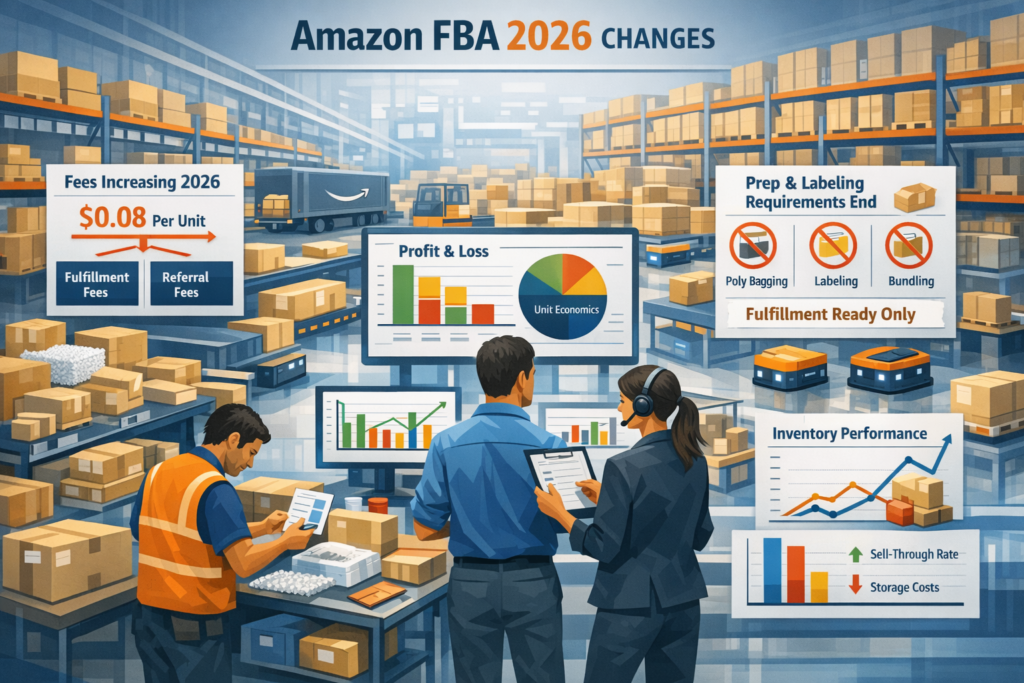
- 2026 increases to Fulfillment by Amazon (FBA), Buy With Prime (BWP), and Multi‑Channel Fulfillment (MCF) fees, averaging about $0.08 more per unit sold in the U.S. — a seemingly modest bump that compounds materially at scale. [SOURCE: Amazon Seller Central]
- The end of Amazon’s prep and labeling services in the United States, requiring sellers to deliver fulfillment‑ready inventory — a shift with immediate operational and cost implications. [SOURCE: packaginginsights.com]
These changes are strategic, not incidental. They reflect the next evolution in how Amazon expects brands to operate — tighter compliance, clearer economics, and less reliance on legacy convenience services. Staying profitable will depend less on reactive tactics and more on systematic financial and operational discipline.
Let’s unpack what’s changed, why it matters, and how successful brands should adapt in 2026.
Amazon’s public documentation confirms that U.S. referral and FBA fulfillment fees will increase by an average of ~$0.08 per unit sold in 2026 relative to 2025, which saw no fee increases. [SOURCE: Amazon Seller Central]
On face value, a sub‑$0.10 bump sounds trivial — but the operative word is average. The reality for most sellers is that:
- High‑velocity SKUs magnify small fee percentages
- Low margin categories have narrower buffers to absorb cost shifts
- Multi‑channel fulfillment and Buy With Prime shipments also see upward adjustments on the fulfillment side
This means CFOs and operators must stop treating fulfillment fees as predictable flat costs. Instead, these fees are variable components of product‑level margins — and they should be baked into every pricing, promotion, and inventory forecasting model.
Actionable Insight: Build fee escalation scenarios into your annual pricing models — preferably by SKU — rather than rolling fee percentages into a single blended margin assumption.
The End of FBA Prep & Labeling: What It Really Changes
Equally consequential is the fact that Amazon has officially ended FBA prep and item labeling services for U.S. inventory in 2026. This was confirmed by multiple industry reports and Amazon notifications to sellers. [SOURCE: packaginginsights.com]
Previously, brands could send inventory to Amazon fulfillment centers and rely on Amazon’s prep service to handle tasks like:
- Poly‑bagging
- Bubble wrap
- Labeling
- Bundling
- Category‑specific packaging
Now, those services no longer exist in the U.S. for inbound shipments. Everything arriving at FCs must already be compliant and “fulfillment ready.”
Operationally, this shifts several responsibilities squarely onto your team or third‑party partners:
- Package Design & Compliance: You must meet Amazon’s strict prep requirements before the shipment closes — not hope Amazon fixes errors after receipt.
- Quality Control: Non‑compliant items risk rejection, return at your cost, or even disposal. In a world where margin compression is real, that’s a direct hit to profitability.
- Prep Labor & SOPs: Whether it’s internal teams or outsourced prep services, you now own the process. This increases COGS in some categories — but also unlocks opportunities to design prep more efficiently than Amazon ever did.
The strategic shift here is simple: Amazon is paying you to operate like a professional shipper. Put another way — the days of FBA absorbing prep variability are gone. If your inventory isn’t ready for prime delivery on arrival, it won’t perform like prime inventory in the marketplace.
The Bigger Picture: Operational Discipline as Competitive Edge
Taken together, these changes reveal a broader pattern. Amazon is nudging sellers toward:
- Clearer cost accountability (fees by SKU instead of averaged at account level)
- Upstream compliance responsibility (inbound quality now yours)
- Efficiency‑first fulfillment expectations (no prep buffer)
For scaling brands, this isn’t a burden — it’s a signal. The brands that thrive in this environment treat FBA costs as variable economics and fulfillment readiness as a competitive weapon, not an afterthought.
Here’s how that plays out in real terms:
Focus on True Contribution Margins
Too many sellers run on headline profitability — total sales minus total costs. In the 2026 model, unit economics matter:
- FBA fees
- Packaging and prep costs
- MCF costs
- BWP fulfillment costs
- Return processing
- Storage and peak surcharges
Model these at the per‑SKU level, and watch how pricing, assortment, and channel decisions shift.
Redesign Prep for Scale
Treat compliance as a product design feature. For example:
- Ask suppliers to ship pre‑labeled, compliant inventory
- Use Ships in Own Container (SIOC) where possible
- Engage third‑party prep 3PLs with process SLAs tied to error rates
When done right, this isn’t cost — it’s operational leverage.
Forecast with Fee Sensitivity
Build scenarios that vary units sold, fulfillment fees, and prep costs. Predict how small shifts in ecommerce demand or fee structures affect your cash flow and margins — not just your top line.
Rethink Inventory Velocity
Inventory that sits too long incurs higher storage fees and aged inventory charges. Tie your repricing cadence and advertising plans to sell‑through rates that respect your refreshed fulfillment economics.
Adapt Now, Win Later
Amazon’s 2026 fee and fulfillment changes may look incremental in isolation, but collectively they redefine the day‑to‑day economics of selling at scale on its platform. Brands that treat these shifts as operational constraints will find themselves advantaged in:
- Margin visibility
- Forecast accuracy
- Compliance and operations
- Strategic pricing decisions
In 2026 and beyond, the marketplace rewards precision.
Pro tip: Build a quarterly review of fulfillment economics tied to fee forecasts, prep compliance scores, and SKU profitability. Doing this consistently separates healthy scaling brands from those simply chasing top line growth.